Inherited
We inherit family ties, a language and a history before we can choose any of them.
 CommunityCoins
ROOTY / Grassroots monetary freedom
Auroracoin, Canada eCoin, e‑Gulden and the other currencies in this alliance were created for communities with histories and identities of their own. CommunityCoins helps their teams maintain the tools each currency needs without taking control away from them.
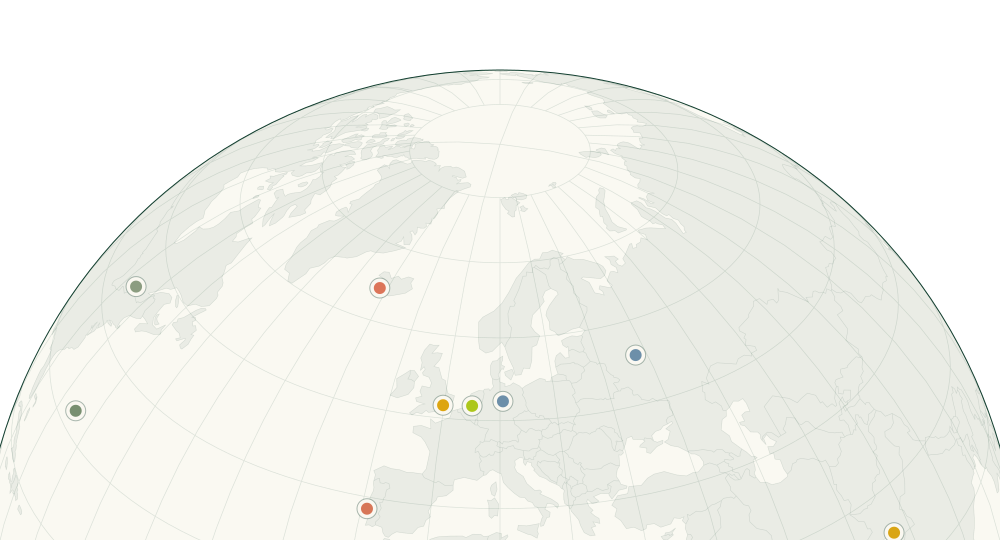
Eleven currencies, each rooted in a different community
Auroracoin was created for Iceland. Canada eCoin began in Canada. e‑Gulden was built as a Dutch monetary alternative. CommunityCoins starts with initiatives like these and helps the people behind them keep their currencies working.
Each team keeps control of its own currency. Through CommunityCoins, teams can share the costly work behind wallets, nodes and mining.
Communities grow from relationships people already have and responsibilities they accept toward one another. A currency can serve those relationships only when the people using it know and accept why it was created.
Before anyone chooses a currency, other people have already shaped where that person belongs.
We inherit family ties, a language and a history before we can choose any of them.
We choose our friends and join associations, workplaces and causes through decisions we make ourselves.
People turn belonging into community when they care for one another and accept responsibility for what they share.
We inherit some bonds and choose others. A community lasts only when its members recognise what they owe one another.
Community requires mutual recognition.
Families, towns, cultural groups and associations make economic choices every day. Almost all of them must measure those choices in money controlled beyond their reach.
Which of the communities I belong to uses a currency that its own members created and govern?
For most of us: none.A shared asset gathers buyers and followers. It does not give them a common history or a duty to keep value circulating among one another.
The crypto industry calls institutional buying “adoption”, yet often dismisses currencies created for real communities as fragmentation.
Anyone can run the software and verify the ledger without asking a bank or state for permission.
No global protocol can decide how people in a town, language group or nation should distribute a currency and put it into daily use. The people concerned must do that work themselves.
“Yes, but we can win a major battle in the arms race and gain a new territory of freedom for several years.
— Satoshi Nakamoto, 2008
The map shows eleven currencies created for a place, nation or cultural community. Each one runs on its own network. Together they show that communities can create monetary systems of their own.
The map is sparse because few communities have created monetary networks of their own. That leaves work to do.
 EFLThe Netherlands
 CESCPortugal
 CDNCanada
 RUBTCRussia
 SLGUnited Kingdom
 FJCJapan
 AURIceland
 NESSBermuda
 PAKPakistan
 DEMGermany
 BOLIVenezuela
CC-WALLET is a joint project of the teams in the CommunityCoins Alliance. It lets people hold, send and receive currencies that already exist. Each currency keeps its own network and rules.
Together, we build and maintain the wallet. People in each community must earn users’ trust and give them real places to spend the currency.
AuroracoinIceland1,240.00
Canada eCoinCanada384.60
Electronic GuldenThe Netherlands92.75
People return to a currency when shops, associations and neighbours accept it. Only people inside the community can decide where that exchange should begin and keep it going.
Give the first coins to members who know one another.
Begin with a shop, association, market or local event.
Arrange the next exchange before the first one is forgotten.
Users see a wallet and expect it to work. Behind that screen, contributors keep nodes online, maintain mining software, publish builds and run wallet services.
Teams package and document core software so another maintainer can rebuild a node and bring it online.
Miners use shared software to produce blocks for smaller networks without depending on a single pool operator.
CC-PROXY gives wallets a simple HTTPS route to chain data supplied by independent nodes.
People create community through shared life and responsibility for one another. A currency can support exchange between them. Decentralised software lets different communities make different monetary choices.
Read the principlesCommunity comes before currency.
A community may create money to serve its own economic life.
A community currency succeeds when people keep using it with one another.
Several independent currencies leave people more than one system to rely on.
Teams may share tools while each community keeps authority over its currency.
Communities can work together and still make different choices.
What remains when cryptocurrency is reclaimed as monetary infrastructure rather than a speculative product?
Read essayA community currency can carry purpose, memory and economic commitment in the same way language carries identity.
Read essayPreserving proven networks is not nostalgia. It can be a deliberate strategy for autonomy and continuity.
Read essayRecognise the communities that already hold you. Discover whether one of these rare beginnings belongs there. Then help give it people, places and recurring reasons to circulate.
Decentralisation is not something
a system grants us.